
By Sonja Heyck-Merlin
It is 7,000 miles as the crow flies between Aroostook County, Maine, and Japan’s northernmost island, Hokkaido. Despite the distance, the two regions geographically align on a map; hold a ruler between them, and the line is nearly horizontal along the 45th parallel.
Add a dot on the line at Aurora Mills & Farm in the town of Linneus, Maine, and another on the city of Obihiro, Japan. The places share fertile soils, long dark winters, and equally long light-filled summers. Now because of a unique partnership between the farmers at Aurora and Tak Sato, who grew up in Obihiro, there’s another connection — buckwheat noodles.
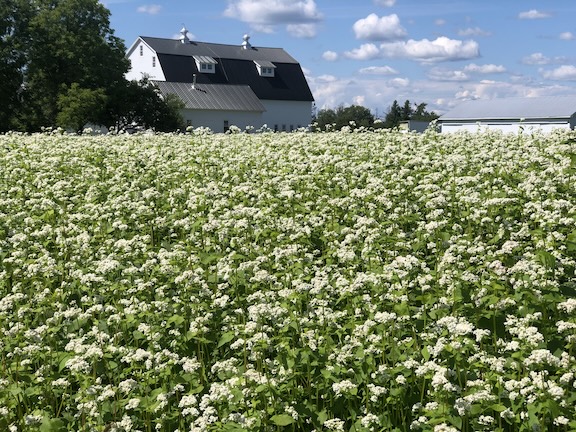
Hokkaido produces approximately 40% of Japan’s buckwheat. Restaurants and food processors in the region also produce a lot of buckwheat noodles known as soba. Both buckwheat as a crop and soba noodles are revered in Hokkaido. One local highway is even nicknamed “Soba Road.” In the summer, the buckwheat flowers blossom into carpets of white or pink depending on the variety. Some towns host buckwheat festivals during blossom time, and area restaurants offer classes on how to make soba noodles.
Born in 1943, Sato grew up eating a lot of prepackaged soba noodles. Eighty years later, they’re still ubiquitous in Japanese cuisine, served hot and cold. “Like McDonald’s. Very popular, cheap, and good,” Sato says. Soba noodles fueled Sato through childhood and adolescent days of ice hockey and downhill skiing. He loved ice hockey, playing through college, and dreamed of playing professionally, but when that didn’t pan out, he decided to see the world. Sato’s passion for winter sports persists; at 80 he’s still playing hockey and ski races recreationally at Pleasant Mountain in Bridgton, Maine.
Sato left Japan in 1972 to manage a Japanese steakhouse in San Jose, California, and then spent 15 years managing another steakhouse in Omaha, Nebraska. He was putting out feelers to launch his own restaurant when an employee with Maine ties suggested Portland as a potential location. In 1984, Sato and a cousin opened Sapporo, bringing some of the first sushi to Maine. When Sapporo closed, Sato launched a new restaurant, also in Portland, called Yosaku, which he recently sold to his sushi chef of 30 years.
While Sato was introducing Mainers to Japanese cuisine, up in Aroostook County, once known as the breadbasket of the Northeast, Aurora owner Matt Williams, was experimenting with grain production. Williams, a University of Maine Cooperative Extension grain agronomist, began growing certified organic food-grade wheat in 1998, and started a milling operation in 2001 to meet the needs of Borealis Breads, a company that wanted to incorporate Maine-grown wheat into their bakery. In 2013, Williams’ daughter Sara, left Washington, D.C., where she worked as a landscape architect, and returned home to help manage the farm, eventually marrying Marcus Flewelling, an Aroostook County native.
As she settled back into farm life, Sara observed that only one crop in her father’s rotation — wheat followed with clover — generated revenue. So, she diversified into oats, rye, spelt, split peas, and buckwheat. “These rotations need to be profitable,” she says. Most crops are marketed as food-grade and sold to restaurants, bakeries, distributors, institutions, and breweries throughout the Northeast. They also sell to some seed companies, such as Fedco Seeds.
When Sara started growing buckwheat she planted Tartary buckwheat, which is not the type of buckwheat customarily used to make soba noodles. While it can be done, the noodles end up being quite bitter. Rather, it’s Japanese buckwheat (Fagopyrum esculentum) that is typically used. Whether Tartary or Japanese, neither is related to wheat. Both kinds of buckwheat are from the same family as rhubarb, sorrel, and knotweed, and produce gluten-free seeds that can function as grains — a pseudocereal.
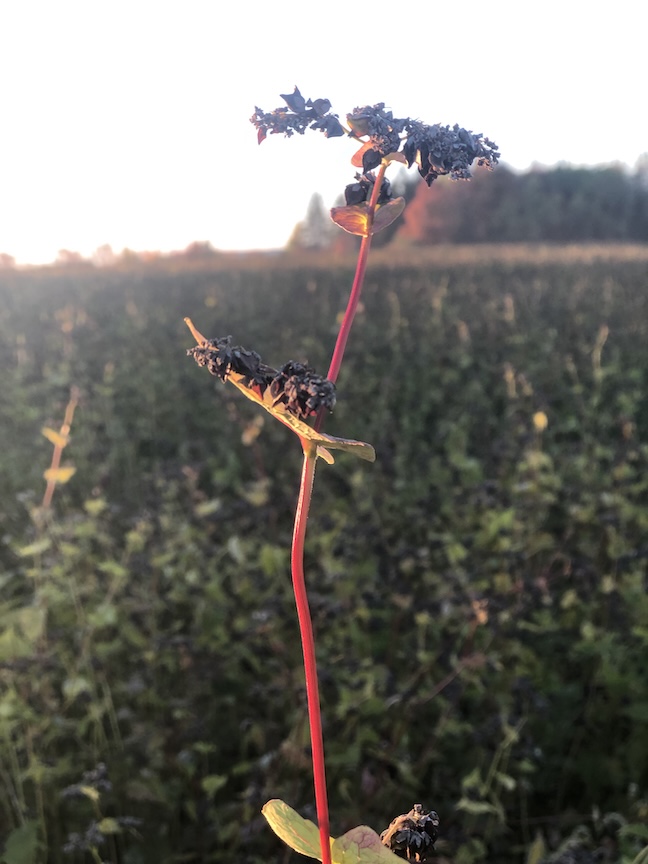
Buckwheat originates from Siberia, the Himalayas, and Manchuria. It was cultivated and eaten in China and eventually spread to other parts of Asia as well as Europe. It’s not just enjoyed in noodle form. Kasha, toasted whole buckwheat grains, is a traditional Eastern European dish. Buckwheat crepes, called galettes, are beloved in French cuisine. The name buckwheat, however, is a misnomer. Because its small, black, distinctly triangular seeds resemble beech tree nuts, it was called “beach wheat” in northern Europe. The Dutch then dubbed it “boecweite” or “boekweite,” and it became known as buckwheat when Dutch settlers introduced it to colonial America.
Sara found benefits to using Tartary buckwheat in her rotations. The annual crop is relatively easy to grow, requiring only 90 days from planting to maturity. It grows fast and has a rapid canopy closure, “effectively reducing the weed seedbank pressure ahead of other crops,” Sara says. Buckwheat is also helpful in bringing idle land into production and can clean the soil of root rot organisms that occur when growing legumes. Sara also says that buckwheat is an exceptional phosphorus scavenger; the plants are very effective at finding phosphorus that’s already present in the soil and making it more available for the following crops.
The disadvantage of Tartary buckwheat, Sara learned, is the size of the seeds, which is similar to that of oat and wheat. She generally follows a buckwheat crop with oats or winter wheat, and it’s typical for buckwheat seeds from the previous year’s crop to germinate in the following year’s crop — so-called volunteers. This size similarity created difficulties in the milling operation as the seed of the Tartary buckwheat volunteers are difficult to separate from the other grains.
Japanese buckwheat seeds, however, are larger than Tartary buckwheat and don’t present such a processing challenge. So, a decade ago, when Sato reached out to Sara and her father about growing Japanese buckwheat for him, Aurora calculated it was a risk worth taking. They already knew how to grow buckwheat, and this type of direct partnership, similar to what they have with Borealis Bread, Allagash Brewing, Blue Ox Malthouse, and Heiwa Tofu, appealed to them. “We just grow our business organically and sustainably one customer at a time. We scale up as they scale up,” Sara says.
Sato was scouting the state for some buckwheat farmers because he’d decided his next entrepreneurial mission was to bring traditional soba noodles to Japanese restaurants in Maine and across the United States. He says that he wanted to build a new business that reciprocated the generosity and support that the people of Maine had provided him.
First though, he needed a high-quality buckwheat flour comparable to what Hokkaido is known for. While chatting over sake with patrons at his Portland restaurant Yosaku, one of them suggested Aurora. A trip to Hokkaido, where Sara and Marcus toured farms growing buckwheat, as well as flour mills and soba production facilities, cemented their partnership and friendship. If Sara is ever in the Portland-area with her two kids during skating season, she’ll pack their skates for a trip to the rink with Sato.
Sato imported a variety of buckwheat called Kitawase, commonly grown in Hokkaido, for Aurora to grow. The majority of the farm’s 75 acres of Japanese buckwheat now ends up in Sato’s mill, which is equipped with specialized small-scale equipment, imported from Japan, to clean, grind, and package buckwheat flour. Sara hires a trucker to transport the buckwheat from Aroostook County all the way to Eliot in Cumberland County where the equipment is located.
First, Sato runs the seeds through a machine that removes any stones, then he takes off the dark hulls. Next, he runs the dehulled grains, now called groats, through a stone mill. “We don’t do any heat,” says Sato. He adds that the slow and cold grinding conditions help preserve the nutrition. He mills about four days a week, everything from a superfine nearly white flour to a course, dark-flecked but flavorful flour. It’s all marketed under the name Aurora Soba and primarily ends up in Japanese restaurants that transform the flour into traditional hand-cut soba noodles. Some restaurants mix different proportions of wheat flour into the buckwheat flour, but Sato prefers 100% buckwheat soba noodles, especially served cold. He makes his own simple dipping sauce using soy sauce, Hon dashi, and warm water, and then adds shredded scallions and daikon horseradish.
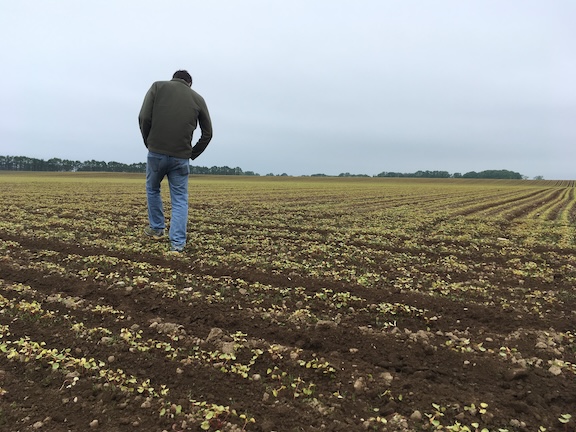
It took a few years of experimentation for Sara and her dad, who has now retired from farming, to achieve consistent yields and quality. Sara aims to plant into a well-prepared field, using a grain drill at 7-inch spacing, on the Monday following the Fourth of July. The mid-summer date helps to avoid heat stress during flowering, which can reduce yields. This timing also prevents the plants from growing too large and falling over, making it difficult to combine and resulting in volunteers in the following year’s crop. Too much fertility can also create this problem in buckwheat. To avoid this, Aurora has found success in planting buckwheat to follow the more nutrient-hungry potato crop at a nearby organic farm. It’s a symbiotic relationship: buckwheat helps break potato disease cycles, particularly that of the cyst nematode that affects potatoes.
Bees, says Sara, are crucial for buckwheat production at this scale, necessitating hosting commercial hives at each of their fields. The bee activity during flowering is so intense that you can actually hear a low hum throughout the field when walking through it, says Sara. According to the beekeeper, the bees serve as a yield predictor; he can predict whether the buckwheat crop will have a good yield based on how much honey the bees are producing from a field.
Sara monitors seed development closely as harvest nears. Marcus, the combine operator, harvests when the seeds are about 80% mature, usually in the beginning of October. Harvesting too late results in seeds falling from the plants before they can be combined. This is called shatter loss. At Aurora’s mill, employees pass the seeds through a scalper and pre-cleaner before placing them in metal storage bins equipped with air and propane systems that dry the seeds to Sato’s target moisture of 16-17%. The use of propane heat is avoided when possible to prevent overheating.
The seeds then move through additional cleaners and gravity tables, which use a combination of air pressure and vibration to sort based on density to remove weed seeds and lightweight chaff. Sara prefers to clean the buckwheat all at once, usually in January, because she says, “It just gets everywhere.” Stray seeds have ambitious tendencies — anywhere one can sprout, even in a crevice in a piece of equipment, it will take advantage of the opportunity.
The capital-intensive harvesting, drying, and grain-cleaning equipment at Aurora, combined with the farm’s decades of production know-how, yields the high-quality groats Sato wants. Like Aurora, Sato continues to invest in specialized equipment. He recently imported a Japanese machine that produces soba noodles, close to the same quality that can be produced by hand. Lots of restaurants in Japan, Sato explains, are equipped with these machines. Instead of just milling buckwheat flour, Sato is gearing up to bring fresh soba noodles — high in protein, the antioxidant rutin, B vitamins, and minerals — to Mainers.
He’s prepared to be patient. Compared to ramen or a typical box of spaghetti, soba noodles, especially those made with 100% buckwheat flour, have a different texture and more robust flavor. Sato mentioned that over 50 years ago, when the first sushi restaurants opened up in the United States, people were skeptical and dismissive. “Everybody laughing. Raw fish. United States. No way,” he says. “Now it’s all over the world. Takes time.”
In Japan, the long and slender shape of the soba noodle symbolizes stability and longevity. Eating soba on New Year’s Eve — a dish called Toshikoshi Soba, which translates to year-crossing noodles — expresses the hope that the New Year will bring longevity, prosperity, health, and protection against bad luck. With a little time, Tak and Sara hope to have the people of Maine slurping down soba noodles, symbolizing not just stability but an agricultural and culinary connection between snowy northern Japan and northern Maine.
Sonja Heyck-Merlin is a regular feature writer for The MOF&G. She and her family own and operate an organic farm in Charleston, Maine.
This article was originally published in the spring 2026 issue of The Maine Organic Farmer & Gardener.