
By Tim King
Zoë Mason of Luna Moth Herbs cultivates a half-acre of medicinal and culinary herbs, amounting to 65 different species, in South China, Maine. Mason opened ground on a plot of leased land in the spring of 2023 after reading that 3 Level Farm was looking for people to live on the farm for the long term. Using no-till practices and a variety of mulches, Mason has grown about 84 different herb species since 2023.
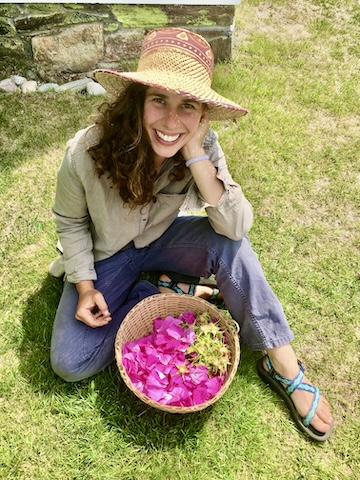
“I grow nearly all the herbs for the herbal products from seed,” says Mason. “I love the buzz of pollinators in the garden and maintain a continuous bloom all season so the bees and hummingbirds stick around. I love the hubbub of the insects, and I feel like a guest at their feast of flowers.”
Luna Moth Herbs’ website presents the herbs for sale as tea blends, herbal extracts, dry herbs, and body care products, such as Arnica Flower Oil and Calendula Kiss Lip Balm. Many of the herbs are used in multiple forms including teas and extracts in different menstruum (solvents or liquids) as well as fresh or dry herbs.
“For example, I grow a good deal of lemon balm,” says Mason, who studied at the Vermont Center for Integrative Herbalism’s Family Herbalist Program. “Lemon balm is a common herb that provides a great base flavor for tea and is often accompanied by lemon verbena. Lemon balm has many qualities, and I consider it a gentle herb that performs well with regular use. It’s non-sedating and calming, and I use it for nervous indigestion. I also make an alcohol extract, or tincture, from the fresh lush leaves and folks use that as a single tincture or in blends.”
Another herb that Mason grows is schisandra, a perennial deciduous vine.
“I delight in growing schisandra, which is a vining plant native to China,” says Mason. “It fruits elegant red berries in early autumn. True to another common name, five flavor fruit, the berries have a unique bite, which adds both color and healing properties to several of our schisandra products, including a fire cider, a tea blend, a vinegar extract, and a tincture. The berries are an adaptogen, supporting resilience, liver detoxification, and balancing energy and hormones.”
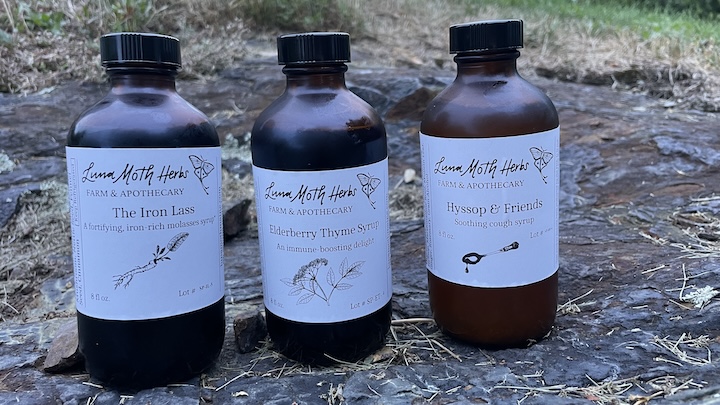
Mason says that herbalist Maria Noël Groves writes that schisandra can be used for sleep as well as giving energy a supporting overall energy balance. The bright red berries in a tea or extract can support a run-down immune system, according to Groves’ book “Body into Balance.”
Luna Moth Herbs often provides the same herb, such as schisandra, in different ways for a reason. Mason personally uses teas, syrups, vinegar extracts, and tinctures and says they each have different purposes.
“I use both regularly but they each fit a different need for routine and use,” she says. “Some folks are looking for alcohol-free remedies, so I provide both teas and alcohol-free herbal extracts made with cider vinegar or glycerite. Tinctures are very shelf-stable and provide a highly potent extraction of the plant’s constituents. Herbal teas are accessible and gently supplement health goals and relaxation. Teas also are more sensory through both smell and taste, and they allow a low-barrier method to connect with the plants and their gifts.”
Take ashwagandha, for example. It’s a member of the Solanaceae family of plants and has been used in Ayurvedic medicine for millennia. “This healing root has gotten quite a lot of press for strengthening, supporting endurance, and as a sleep aid,” says Mason. “The properties are best extracted with soluble fats, so if you choose to make a tea with these dried roots, simmer them in water for 15 minutes and then add some milk. Alternatively, grind the roots in a coffee or spice grinder, then warm the powder in any milk of your choice, such as nut, oat, coconut, or dairy.” She adds, “I like to grind the roots with a shake of cinnamon, cardamom, fennel seed, and nutmeg to make a rich chai-like evening beverage. I also love to drink ashwagandha root with cocoa and maple syrup for a daytime treat.”
Schisandra berries make another appearance in the apothecary’s herbal répertoire in fire cider, which Mason describes as a spicy apple cider vinegar and honey tonic. Hers is made with fresh homegrown schisandra berries, habanero peppers, and a medley of other pungent and immune-supporting herbs. She says that fire cider, a popular folk remedy, is a little sweet and a little spicy.
Luna Moth Herbs also grows culinary herbs, packages them, and sells them in both individual packages and in bundles. An herbal blend to add to soup stock is also available. “The Soup Stock Herbs unite the healing power of Maine’s many environments including responsibility harvested sugar kelp from the Atlantic, field nettles harvested in spring from a friend’s seed farm, and reishi mushrooms from the forest spirit, responsibly harvested or grown locally,” says Mason.
The inclusion of culinary herbs among Mason’s medicinal herb product mix was developed mainly to increase the appeal of Luna Moth’s herbs to wholesale buyers.
“I started off without having any culinary herbs in my crop plan,” she says. “I was focusing completely on the niche to supply fresh and dry healing herbs, but I wasn’t having much success in sales, so I diversified to include more culinary herbs in my second year of production.”
In addition to selling directly to customers at the Rockland Farmers’ Market, Luna Moth Herbs sells wholesale to 12 retail vendors in Maine including Washington General Store, Fernald’s Country Store, The Milkhouse, and Olive Rose Chocolates. Mason is hoping to add to that list. She also has products at Elleyo, a jewelry store in Jamaica Plain, Massachusetts, and sells herbs via Daybreak Growers Alliance in Maine.
As Mason worked to increase her sales to retail and wholesale vendors, she decided that Luna Moth Herbs could get a marketing advantage by becoming certified organic and began looking into what was needed.
“I was already using organic practices from the get-go for Luna Moth Herbs,” says Mason. “My experience prior to starting my own business was in organic production, so I understood that and was committed to those practices.”
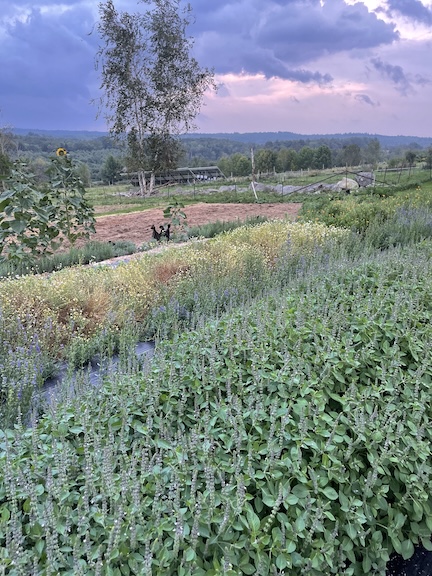
While Mason’s production practices needed to be certified, that wasn’t her big challenge. Certificationof all the post-harvest aspects of an herb business was going to make a complex business more complex. That’s where the Transition to Organic Partnership Program (TOPP), a program that matches transitioning organic farmers with established producers, came in.
“I was interested in the mentorship aspect of TOPP,” she says. “I wanted to have support and accountability as I navigated the paperwork and created record-keeping systems. From using complex record-keeping systems at other certified herb farms, I knew it was not going to be a walk in the park to build them myself.”
Once Mason signed up for TOPP through MOFGA, she needed to be paired with a mentor. Meg Mitchell, MOFGA’s former organic transition specialist, connected over 30 mentor-mentee pairs during the life of the program, and she connected Mason with Carole Mapes of Flywheel Flowers of Jackson, Maine.
“Both Carole and I grow a mix of annuals and perennials, and we both grow value-added products,” says Mason. “I specialize in dry herbs and she does dry flowers. Certifying two scopes, both crop production and processing, was a rather unique endeavor, so I think Meg matched us based on the knowledge and experience Carole had with these realms.”
The processing and handling of harvested herbs plays a major role at Luna Moth Herbs. “The farm and the apothecary are essentially two branches of the same business,” says Mason. “After harvest, we transport the fresh herbs to the drying facility where they are laid out on tables or drying racks, labeled with the crop and lot number, and dried between two to twelve days, depending on the crop and moisture. Then we process, or garble, them right away, or put the dried herb into storage.”
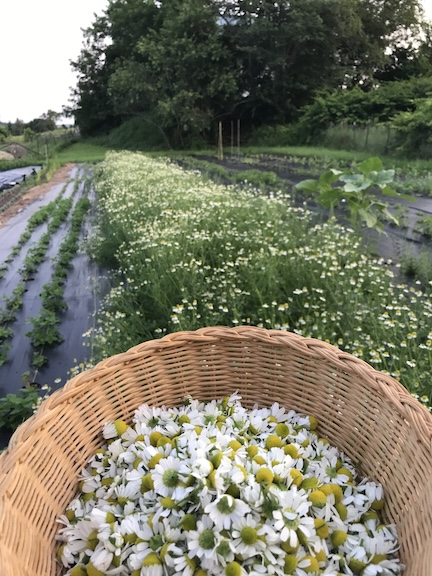
Once Mason and Mapes got to know each and their respective business operations, they got to work getting Luna Moth Herbs certified organic.
“We started off with frequent Zoom meetings and email correspondence,” says Mapes. They then kept in touch via email, and met in person at the beginning and at the end of their time working together.
Mapes helped Mason create a system of record-keeping that Mason describes as scrupulous — it records every aspect of the herb business. Developing the new systems for organic production was particularly challenging for Mason because she was dealing with seedling production, herb processing, winter markets, and an off-farm job within just a couple of months.
“I balanced those challenges with the fact that there was a state-funded reimbursement for the certification fees,” says Mason.
Thanks to the guidance from Mapes and the TOPP program, Luna Moth Herbs has been certified organic since 2024 and continues to build its wholesale business.
Mapes found the experience valuable, too. “I’d do it again,” she says. “I enjoyed building a rapport with another farmer and sharing what knowledge I can with her.”
By the end of 2024, TOPP had delivered thousands of hours of technical assistance to farmers transitioning to organic and organized nearly 1,500 events for farmers and agricultural professionals. The program helped over 3,800 operations get over 260,000 acres of land certified organic, according to the 2024 TOPP impact report.
With help from MOFGA, Mason’s Luna Moth Herbs was among a number of Maine farms to use the resources provided by TOPP to transition to certified organic. Mason, who works as a garden and outdoor educator for the Belfast school district, says she hopes to become a full-time organic herb farmer and herbalist in the future.
Tim King is a produce and sheep farmer, a journalist, and cofounder of a bilingual community newspaper. He lives near Long Prairie, Minnesota.
This article was originally published in the spring 2026 issue of The Maine Organic Farmer & Gardener.