
Lee Auto Malls, a third-generation family-owned auto dealer with 13 locations across the state, supports causes they care about through a unique approach to marketing. “I have tried for the last 25 or 30 years to put together some kind of promotion that doesn’t just help us,” says Adam Lee, chairman of the board. To that end, six or eight times a year Lee Auto Malls highlights different organizations — from Maine Audubon and the Natural Resources Council of Maine, to the Maine Civil Liberties Union and Maine Equal Justice Partners — on Maine Public Broadcasting. The promotions let listeners know what Lee Auto cares about, while giving airtime to the organizations and supporting Maine Public, where Lee chairs the board.
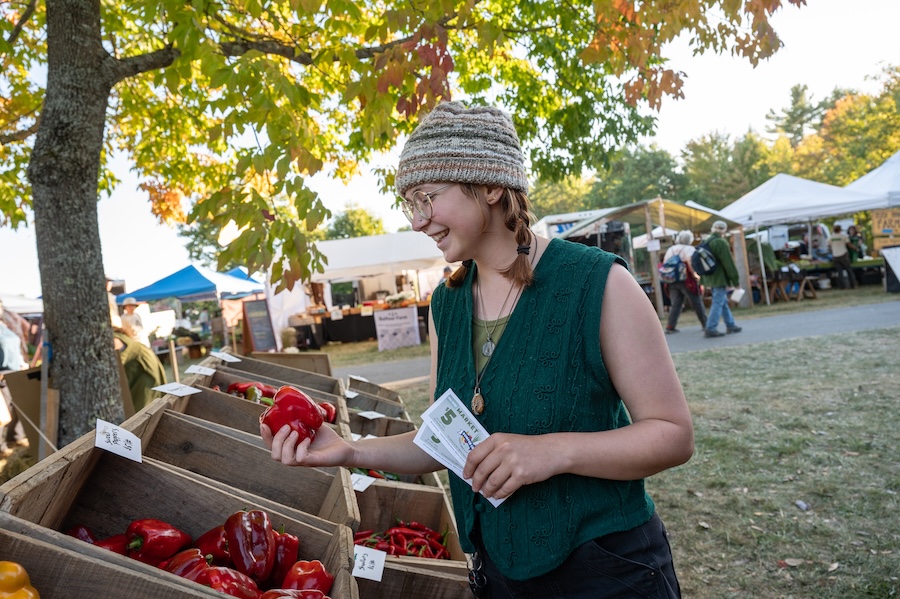
Photo by Kelsey Kobik for Maine Federation of Farmers’ Markets
The list of organizations also includes MOFGA, where Lee served as a board member for nine years. “I just feel the work they do is important,” says Lee. “ We, in our lifetime, will see monarch butterflies become extinct, and that’s because of Roundup, and we don’t take it seriously … And MOFGA, to me, is that organization that’s sending up the warning shot, like, ‘Listen, we cannot keep poisoning the earth.’”
For the past several years, Lee Auto has sponsored farmers’ market gift certificates, called Bumper Crop, as a MOFGA membership incentive leading up to the Common Ground Country Fair — turning a corporate gift into an ongoing, community-centered impact. This thoughtful approach not only builds MOFGA’s member community but also directly supports farmers and strengthens Maine’s local food system.
”You join and you get the Bumper Crop coupons, and then you walk through the gate and there’s whole acres of farmers selling wonderful stuff that you can pay for with this,” says Lee.
And the money “just goes right back into the local food economy,” adds James DeBiasi, executive director of the Maine Federation of Farmers’ Markets, the nonprofit that administers the Bumper Crop program.
Bumper Crop launched in 2019, when a Bangor-area employer wanted to give their staff gift certificates that would be valid at multiple local farmers’ markets as part of a wellness initiative. MFFM drew upon their existing relationships with farmers’ markets, and their experience administering Maine Harvest Bucks for Supplemental Nutrition Assistance Program (SNAP) participants, to create a new kind of “currency” for Maine’s farms, broadening local food access across all income levels.
That year, MFFM submitted a three-year grant, with MOFGA as a collaborator, to get Bumper Crop off the ground, one employer-backed wellness initiative at a time. Then in 2021, Lee Auto Malls made a contribution that would quickly scale the program — and its impact. Thanks to a partnership with Lee Auto, $20,000 worth of Bumper Crop was distributed during Maine Public’s membership drive.
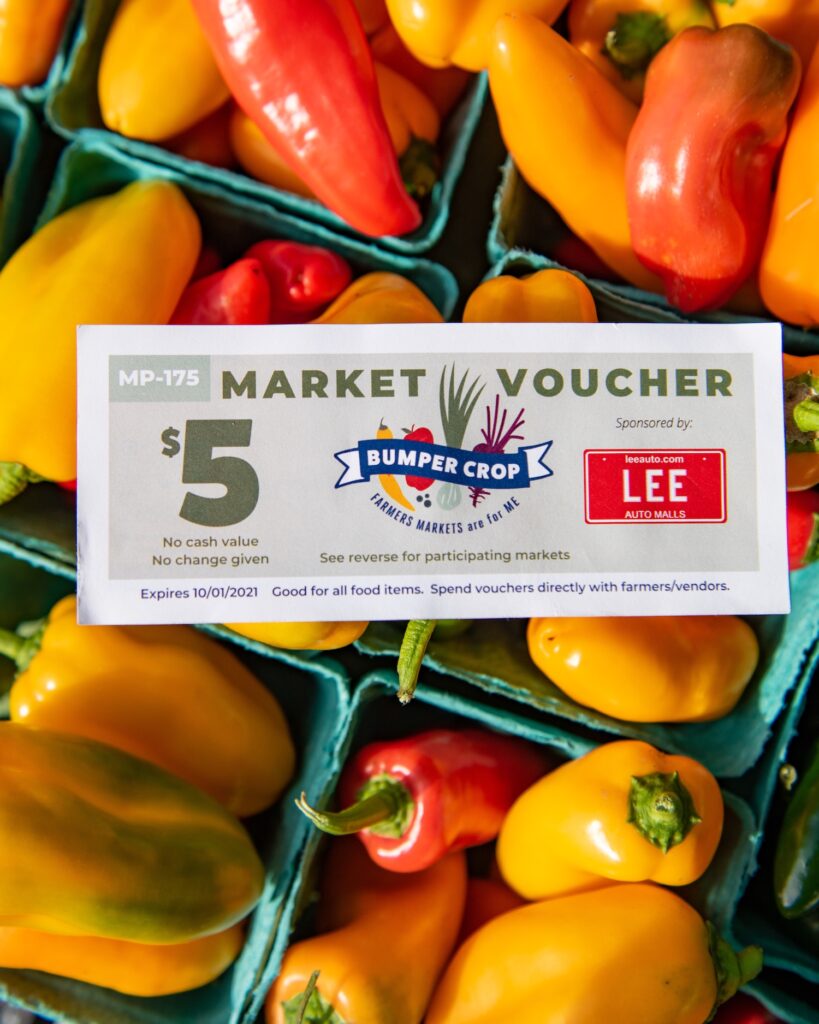
Today Bumper Crop is primarily supported through workplace wellness programs — one of 49 participating employers mailed out $400,000 in Bumper Crop vouchers to 14,000 employees in 2025 — but Bumper Crop, like most gift certificates, can be purchased by anyone. Some local organizations, for example, purchase Bumper Crop and donate it to food pantries to be distributed among patrons.
For each and every $5 Bumper Crop voucher spent at one of Maine’s 82 farmers’ markets, the value goes straight to farmers. In 2025, $180,000 in Bumper Crop was spent at markets across the state. “That’s a number that is concrete that we can celebrate,” says DeBiasi.
Not only that, but data collected by MFFM shows the impact to be greater than the face value of Bumper Crop spent. From surveys conducted by the organization, 40% of shoppers who used Bumper Crop report going to the farmers’ market more frequently because the vouchers reintroduced them, or introduced them, to their market. DeBiasi hopes that Bumper Crop helps build lasting shopping preferences and behaviors for Mainers. “I hope it gets them to pause and orient their grocery shopping around farmers’ markets and local farms more,” he says.
MFFM speculates the total amount of Bumper Crop spent at markets annually has a financial impact two or three times its value, when accounting for “additional cash sales from people spending their own money,” says DeBiasi. “We feel pretty confident that every year it is making a substantial drop in farmers’ gross income, especially those that sell at farmers’ markets.” He says that Bumper Crop also impacts market viability. “At some of our markets, Bumper Crop is one of three currency programs happening that might comprise 5 to 40% of total sales at that market.”
DeBiasi credits Lee Auto Malls with jumpstarting Bumper Crop. By supporting MOFGA and Maine Public in this unique way, “it allowed this voucher program to scale quickly and to benefit multiple markets quickly,” says DeBiasi.
“This thoughtful approach shows how philanthropy can go beyond a one-time donation to build lasting relationships and strengthen Maine’s local food economy,” says Mary Weitzman, MOFGA’s membership and development director. “MOFGA is deeply grateful to Adam Lee and Lee Auto Malls for their continued leadership and for inspiring others to think creatively about how their generosity can nourish farms, families, and communities across our state.”
This article was originally published in the spring 2026 issue of The Maine Organic Farmer & Gardener.