
By Jacki Martinez Perkins
We never truly know what kind of disaster can befall our farm and our livestock. As we leave behind the danger of winter ice storms and approach the seasons of spring flooding, summer drought, and fall hurricanes, it becomes a daily reality that something will go wrong, and it’s just a matter of time. The term “disaster” doesn’t only apply to the natural variety either. Disasters are defined by their nature of being overwhelming. We must consider the gamut: contamination, disease outbreak, neighborhood fallout, personal family drama, financial catastrophe, and political upheaval are just some of the disasters that can potentially keep us up at night.
A great strategy for being prepared for any overwhelming situation is to assess your risk. Risk is a mix of hazards, vulnerability, and exposure. For example, with livestock there’s a hazard of disease outbreak, and your farm’s vulnerability to that would be the vaccination rate/herd immunity to that disease, while the exposure is the prevalence of disease in your area. Ask yourself: “What is likely to happen?” as well as “What is not likely to happen?”
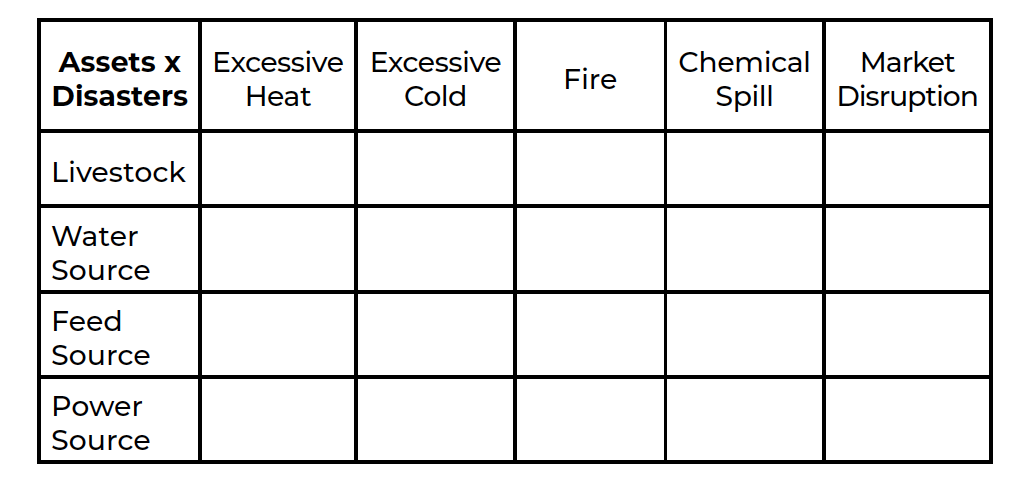
A helpful group activity to put our potential risks into perspective is to make a chart that consists of a list of assets (i.e., feed, tractors, roads, manure piles, etc.) vertically down the page with potential disaster events horizontally across the top of the page. Then give each event a score of 1 to 5 (low impact to high impact). Start by thinking about yourself, then the neighbors, then the town, then the state, then even broader.
Mitigating your risk starts with being prepared. Have the correct kind of fire extinguisher for each particular zone, and make sure that they’re charged or give them a shake to remix the contents. Take into consideration that when dealing with confined spaces and fires (like welding in a pit), not all local emergency response teams are trained for handling those situations, and let them know the activity is taking place before there’s trouble. Assemble a livestock first-aid kit. It should contain pain mitigation medications appropriate for livestock; something to stop bleeding (human bleed packs can work, but take care with puffy, absorbent material as it may not apply the necessary pressure); and a good identification system in case loose animals are an issue. It’s recommended to keep vaccinations for respiratory and reproductive diseases up-to-date in case of a forced comingling event with outside herds or flocks.
Make a contingency plan that includes a color-coordinated map of the property and consider including slopes so that emergency services can help you evaluate risk factors after a disaster event, such as fire-retardant runoff into drinking water sources. Share it with everyone, including local police, the fire department, and emergency medical services, and your neighbors. When calling in an emergency, tell communications operators where things/animals are located so that they can best aid your farm and not make things worse. For example, let them know if you have a livestock guardian dog that may be protective and potentially bite, or that cattle are in pastures and fences/gates should not be left open. It is even possible to designate part of your property as a Life Flight Landing Zone. This is a 100-foot-by-100-foot area that can be pre-loaded into EMS systems to benefit the entire neighborhood.
Some fairgrounds agree annually to be temporary holding sites for livestock. It is in the best interest of livestock owners to know if their local fairgrounds is such a site, and how feed and water would be sourced, stored, and distributed in all seasons. The MOFGA fairgrounds is such a place but livestock owners would be at a loss during the winter, as there is nowhere to store feed and water becomes unavailable.
If there is a need to evacuate with livestock, it can be helpful to work in teams with a lead car that determines if a route is safe and accessible to a truck and trailer. It is also advisable to keep an out-of-state contact because local communication services often fail, while long-distance services may not be affected. Cell phone tower systems rely on the ground grid to work. Satellite phones also have their limitations. Radios are the most effective.
In reality, it is the responsibility of the farm owner to consider and mitigate their disaster risk. The true role of the Federal Emergency Management Agency (FEMA) is to hand out disaster relief funds, not actually participate in immediate disaster aid. It is the job of local communities to organize the actual aid and delegate who accomplishes that. You must regularly work with your community if you want a functional plan in place.
As MOFGA’s organic dairy and livestock specialist, Jacki Martinez Perkins brings the knowledge she has gained from her upbringing, education, and her experiences abroad, to bear on the unique challenges that face Maine’s dairy and livestock producers.
This article was originally published in the spring 2026 issue of The Maine Organic Farmer & Gardener.