
By Deb Michaelsen
My livestock guardian dog (LGD) story started with a photo I saw on a Facebook group for people raising chickens in their backyards. The photo showed a big white dog sleeping in a barnyard with chickens around and even on top of it, and it got me thinking.
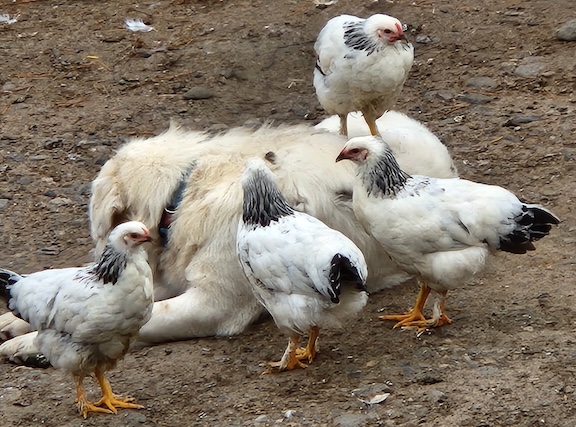
My first livestock addition to my small farm in Waldoboro, Maine, was a small flock of dual-purpose hens that I wanted to be able to free-range for tick, weed, and garden-pest control. Within a year I lost one hen to a bobcat and two more in a single afternoon to a fox. I realized if I wanted my chickens to roam safely I either needed a whole lot of fencing or something that would act like a fence — like a dog.
My partner Lee had long wanted a dog. I grew up with both cats and dogs but favored cats as they required less attention, ate less, shed less, and didn’t tend to chew things when they were left alone. But with an LGD, Lee could have his dog. It would shelter in the barn, not the living room, and keep the chickens safe.
We started out by talking with the breeder about which of her Akbash-Mastiff mix LGDs would be happy guarding two humans, an elderly cat, and three chickens. The three choices she suggested were all 1.5-year-old females. Females of this breed mix tend to be smaller, which appealed to me since the males could be within 20-30 pounds of my own body weight.
Next, we considered fencing, thinking the most flexible option was a pair of Halo collars, which would let us set a virtual fence line via our smartphones that the collars would sense and signal via sound or vibration when a dog got close to the boundary line. Yes, a pair, because when we met the LGD candidates — Peanut, Angel, and Genie — Lee thought we should get two. Peanut and Angel would be company for each other, and we would each have our own dog.
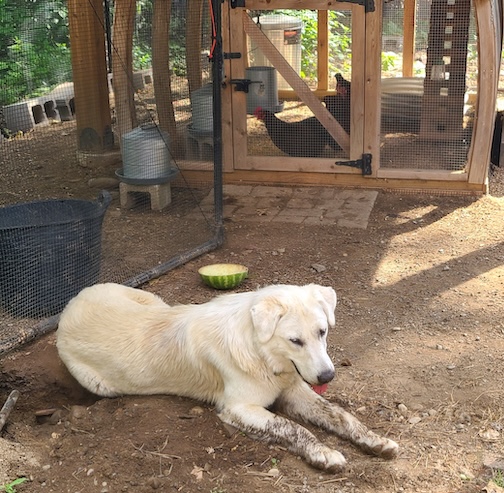
What follows are some lessons that we learned along the way.
Mistake #1: If you have no experience with this type of dog, start with one. Even if you have experience, start with one. The work required to get an LGD to acclimate, bond with its flock, understand what you need it to do, and to get you to understand what you need to do in return is significant. Give the dog its best shot. The only silver lining to having made this mistake was that if we had chosen only one dog, we would have chosen the wrong dog for our situation. See Good Decision #3.
Good Decision #1: We paid to board the dogs with the breeder for three months while we got things ready for life with dogs. We bought leashes, dog bowls, dog toys, and dog food. We cleared out a corner of the barn where they could sleep and put up a tether for their first one to two weeks on the farm so that they learned where home was.
Good Decision #2: We asked the breeder when she delivered the dogs to tell us what we needed to know. We took lots of notes on commands and what to do when. This was valuable information we might not have gotten otherwise.
Mistake #2: We thought LGDs were dogs. While LGDs are biologically dogs, in reality they behave like a whole different animal. Lee and I learned that the hard way, and it almost ended our 15-year relationship. For starters, LGDs are working dogs and even their play is practice for chasing off or taking down predators. They’re not motivated to do tricks, and they don’t come running to greet their humans with wagging tails or see any benefit in retrieving a stick thrown their way. In fact, they are much more likely to respond to something thrown at them as a threat and switch into full guard mode. And because they need to know what’s out there to guard against, they need to go out there and smell it for themselves even if that means digging out from behind a fence or jumping over it.
Most of our spring and summer months were spent keeping the dogs on our property and trying all manner of ways to keep them from barking 24/7 at everything that they viewed as strange or suspicious, which was pretty much everything about their new living situation — including us.
Good Decision #3: We realized that our situation was not good for Peanut and worked with the breeder to find her a better home. It took a while to realize that while we were working almost exclusively to train Peanut to follow — or at least give serious consideration to — our commands, her sister Angel was quietly and consistently doing what we asked Peanut to do without treats. Thankfully we reached that point early enough that Peanut was accepted back with her fellow LGDs, to move to a new and better-suited forever home.
Mistake #3: Building on Mistake #2, livestock guardian dogs are bred and trained to be independent decision-makers. When you say “come,” they know what that means, but they will not rush to your side until they have determined it is safe to do so. Our experiences with dogs as pets led us to equate hesitation following a command with disobedience. That is not the case with LGDs. Rather hesitation is the intelligent and centuries-old instinctive evaluation of the command and the determination by the dog given the command that it is safe for the flock, the dog, and the command-giver to obey. If you want a dog to blindly obey you, these are not the dogs you seek.
Mistake #4: We underestimated what LGDs require to trust humans as their partners. It takes a lot of time, much more than we were prepared for. We were thinking weeks. It took months. Maybe it would have taken fewer months with one dog, along with visual fencing and real livestock, but we started with two LGDs, invisible fencing, and a small flock of hens that weren’t acclimated to dogs.
There have been more mistakes and more good decisions since, and here is where I need to say whether I would do it again knowing what I know now. The answer is no. No without visual fencing. No without real livestock. No without the kind of lifestyle and farm routine that gets me outside more of the day than less. No with two dogs to start.
The answer is also yes. The day Peanut left I saw Angel chasing her tail. This had been my signal to let Peanut off tether so the two of them could romp in the back field. Ears up, tails up, they chased each other, practiced taking down predators, and chased chew sticks I threw for them. So, I went out and Angel followed me to the back field. I threw a chew stick. She chased it, brought it back. I threw it again. Instead of going for it, she ran to face me with ears up, tail up, and pounced with her front legs spread apart like a dare. I jumped up, and pounced down with legs apart, and we romped. We romp every morning and most nights.
Yes, because now that she trusts me, she humors me. Rolls her eyes when my aim is off and the chew stick hits her nose. Yes, because she guards me, and what she perceives is important to me. I don’t have to ask — she knows it’s her job. My job is giving her the space between my command and her response. Trusting that her senses are far superior to mine, I teach her what matters to me and what is not hers to worry about.
Finally, without hesitation, yes because I don’t own a dog. I am a partner with a dog. A dog who knows her job and lives to fulfill her ancestral purpose. Who enjoys a romp but would rather guard my hens and my garden because I care about them. And who will be ready, willing, and able to give safe harbor to our next farm addition — a small flock of fiber sheep!
Deb Michaelsen is a lifelong organic gardener and newbie farmer living in Waldoboro, Maine. Her farm name means “growing wild in a cultivated place,” and she hopes to share the lessons learned from creating Agrestal Farm with others who cherish wild things.
This article was originally published in the spring 2026 issue of The Maine Organic Farmer & Gardener.